
Best Blood Pressure Monitor for Home Use (2026)
By the BP Monitor Lab editorial team · Written from manufacturer documentation and published guidance, not from our own device testing · Last checked: August 23, 2026
Five monitors still sold under the exact model number we name, checked against the maker's own documents. We do not test devices, and we link every claim to its source.
Quick comparison
| Monitor | Cuff fits | Irregular rhythm | Syncing | Typical price |
|---|---|---|---|---|
| Omron PlatinumBP5465 | 9 to 17 inches | Screens for AFib | Bluetooth | $50 to $100 |
| Withings BPM ConnectWPM05 | 8.7 to 16.5 inches | None | Wi-Fi and Bluetooth | $100 to $200 |
| Omron EvolvBP7000 | 9 to 17 inches | Flags an irregular beat | Bluetooth | $50 to $100 |
| Beurer BM67BM67 | 8.6 to 16.5 inches | Flags an irregular beat | Bluetooth | Under $50 |
| A&D Medical UA-767FUA-767F | 8.6 to 16.5 inches | Flags an irregular beat | None | Under $50 |
Price bands are what these usually sell for, not a quote. Check the live price before you buy.
Why each one is here
Omron Platinum
Best overall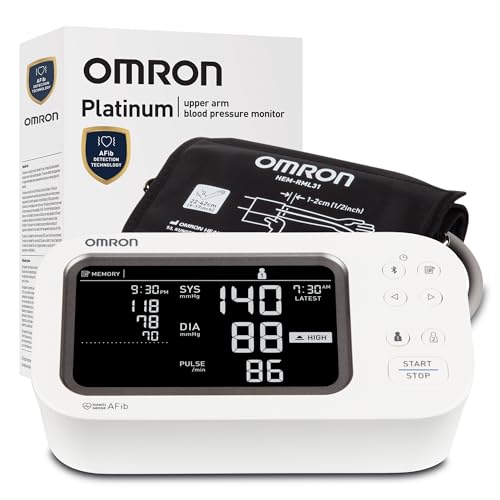
Most homes. It screens for AFib and flags high morning readings.
Cuff: 9 to 17 inches Wide-range D-ring cuff, included.
Good
- 2 people, 100 readings each on the device
- Averages several readings for you in one sitting
- We can cite independent validation for this exact model
- Flags high morning readings, when risk is highest
- The wide-range cuff covers most adult arms without a second purchase
Not so good
- Bluetooth only, so no Wi-Fi upload
- App setup takes a few minutes
Withings BPM Connect
Best for a household
Households where several people share one monitor.
Cuff: 8.7 to 16.5 inches Cuff and monitor are one piece.
Good
- 8 people, 8 readings each on the device
- We can cite independent validation for this exact model
- Charges about twice a year
- One piece, no loose tube to catch
Not so good
- No ECG despite the smart looks
- Readings live inside the Withings app
Omron Evolv
Best for travel
Travel. The whole monitor is the cuff, so it packs flat.
Cuff: 9 to 17 inches Cuff and monitor are one piece. Nothing to plug in.
Good
- One user, 100 readings on the device
- Averages several readings for you in one sitting
- We can cite independent validation for this exact model
- The monitor is the cuff, so it packs flat
- Nothing to plug in
Not so good
- One user only
- Takes practice to position the cuff
Beurer BM67
Best for four users
Four people on one monitor, each with their own memory slot.
Cuff: 8.6 to 16.5 inches Large cuff included.
Good
- 4 people, 30 readings each on the device
- Large backlit screen you can read without glasses
- Batteries and a case are in the box
Not so good
- We could not verify an independent validation for this exact model
- Beurer does not describe an averaging mode on it
- App is plainer than Omron's
A&D Medical UA-767F
Best without an app
Four users, 60 readings each, and no phone needed at all.
Cuff: 8.6 to 16.5 inches Wide-range cuff included.
Good
- 4 people, 60 readings each on the device
- Averages several readings for you in one sitting
- We can cite independent validation for this exact model
- No account to make, nothing to pair
- One button to take a reading
Not so good
- Nothing syncs anywhere
- You copy readings out by hand
Where our facts come from
- American Heart Association, Monitoring Your Blood Pressure at Home
- 2025 AHA/ACC High Blood Pressure Guideline, which replaced the 2017 guideline in August 2025
- US Blood Pressure Validated Device Listing, American Medical Association
- Omron Healthcare, clinical validation by model
Frequently asked questions
What makes a home blood pressure monitor accurate?
Two things matter most. First, cuff fit. Measure around your upper arm halfway between shoulder and elbow, then match that number to the cuff range. A cuff that is too small reads high. Second, published validation. Look for a device the maker has tested against the ISO 81060-2 standard, or one listed at validatebp.org. Then sit still for five minutes with your feet flat and your arm at heart height before you press start.
Is upper arm or wrist better for home use?
Upper arm is better for almost everyone. A wrist monitor reads high when your wrist sits below heart level, and it is easy to get that wrong. Choose a wrist model only if a cuff will not fit your arm or hurts too much, and hold your wrist at heart height every time.
How often should I measure my blood pressure at home?
The American Heart Association suggests two readings in the morning before you take any medicine, and two more in the evening, for the seven days before an appointment. Write all of them down and take the whole list with you. One reading on its own tells a doctor very little.
What cuff size do I need?
Measure around your upper arm at the midpoint. A standard adult cuff covers about 22 to 32 cm, which is roughly 8.7 to 12.6 inches. A large adult cuff covers about 32 to 42 cm, or 12.6 to 16.5 inches. The wrong size can shift a reading by 5 to 15 mmHg, which is enough to change what your doctor does next.
Do I need a Bluetooth blood pressure monitor?
No. A standalone monitor measures just as well. Bluetooth only helps if you want the readings logged for you. If you would rather not have a phone involved at all, a monitor with no app works fine, as long as you keep a written log.
Which blood pressure monitors does the AHA recommend?
The American Heart Association does not endorse brands and does not validate devices. It advises picking a monitor with independent clinical validation. The US Blood Pressure Validated Device Listing at validatebp.org, run by the American Medical Association, is where you check whether a specific model qualifies.