
How to Take Accurate Blood Pressure at Home
By the BP Monitor Lab editorial team · Written from manufacturer documentation and published guidance, not from our own device testing · Last checked: August 28, 2026
Your technique matters as much as your monitor. A validated cuff used badly will hand you a worse number than a cheap cuff used well, and the errors all push the same way: nearly every common mistake makes your blood pressure look higher than it is.
That is worth sitting with for a second. Sloppy technique does not add random noise you can average away. It adds a bias in one direction. Someone who measures over a sleeve, with an unsupported arm, straight after coffee, can read 30 mmHg high every single time and never know it. Below is the method the American Heart Association publishes for home measurement, and what to do with the numbers once you have them.
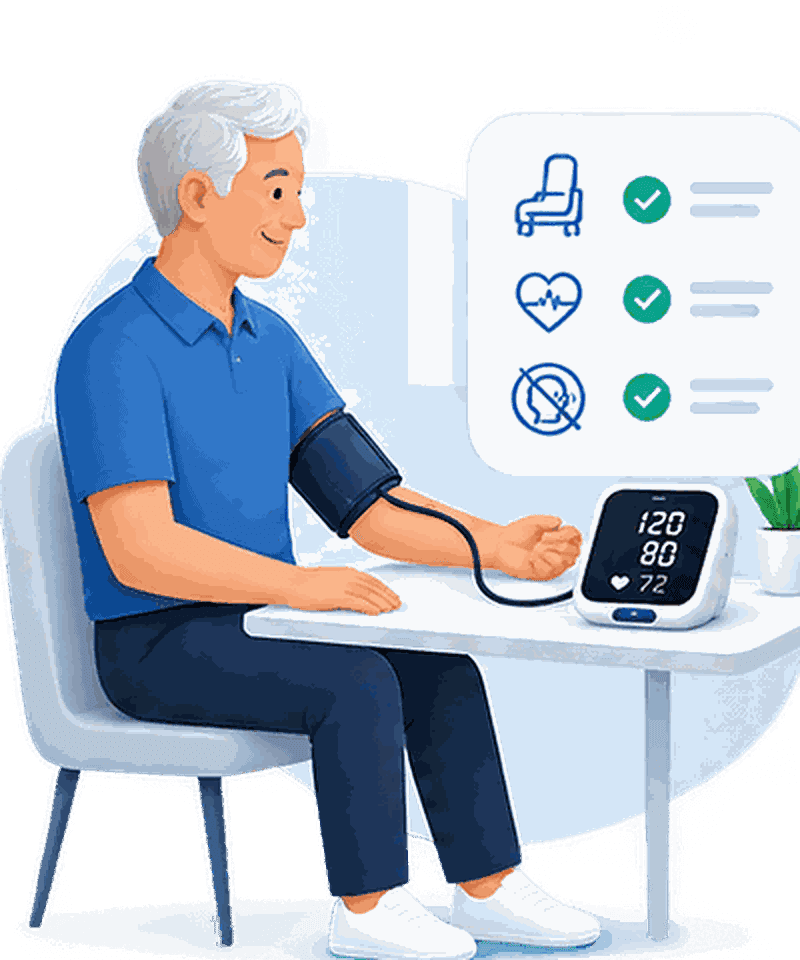
The 30 Minutes Before You Measure
Most of the damage is done before the cuff ever inflates. Half an hour of ordinary life can move a reading more than a medication change does.
- • No caffeine, exercise or smoking for 30 minutes. All three raise pressure for longer than people expect.
- • Empty your bladder. A full one is worth about 10 to 15 mmHg on its own.
- • Do not measure straight after a meal. Give it half an hour.
- • Be warm. A cold room raises blood pressure. So does a cold cuff.
- • Then sit still for 5 minutes. Not two. Five. This is the step people skip most.
Step-by-Step Method
1. Prepare your body
No caffeine, exercise or smoking for 30 minutes. Empty your bladder. Do not measure right after eating.
2. Sit correctly
A dining chair, not an armchair or a sofa. Back against the back of the chair, feet flat on the floor, legs uncrossed. Sit still and quiet for 5 minutes.
3. Bare your arm
Take your arm out of the sleeve rather than pushing the sleeve up. A rolled sleeve becomes a tourniquet above the cuff and changes the reading.
4. Position your arm
Rest your arm on a table so the cuff sits level with your heart, elbow slightly bent. Do not hold your arm up yourself, and do not let it hang.
5. Place the cuff correctly
The bottom edge sits about 2 to 3 cm above the bend of your elbow. Line the tubing up with the middle of your inner arm. Snug enough that two fingertips just slide under it.
6. Stay quiet and still
Do not talk, read your phone, or watch television while it inflates. Talking alone is worth 6 to 17 mmHg. Breathe normally. If a symbol you do not recognise appears afterwards, look it up rather than guessing.
7. Measure twice
Take a reading, wait one full minute, take another. If the two differ by more than 5 mmHg, take a third and average them.
8. Record every reading
Write down the top number, the bottom number, the pulse, the date and the time. Record the high ones too. A log with the bad days deleted is not a log.
Which Arm Should You Use?
The first time you use a new monitor, measure both arms. Most people read a little differently on each side, and the difference is not a fault in the machine. Once you know which arm runs higher, use that arm every time. Always using the lower arm quietly understates your blood pressure for years.
A steady gap of more than 10 mmHg between arms is worth mentioning to your doctor. It is usually nothing, but it is one of the few things a home cuff can surface that a single clinic visit will miss, because clinics rarely measure both sides.
Common Mistakes
These figures come from the AHA's scientific statement on blood pressure measurement. Notice that every one of them pushes the same direction.
| Mistake | Effect on Reading |
|---|---|
| Cuff over clothing | +5 to +50 mmHg |
| Talking during measurement | +6 to +17 mmHg |
| Full bladder | +10 to +15 mmHg |
| Arm unsupported or too low | +4 to +10 mmHg |
| Back unsupported | +6 to +10 mmHg |
| Cuff too small for the arm | +2 to +10 mmHg |
| Coffee in the past 30 minutes | +4 to +10 mmHg |
| Legs crossed | +2 to +8 mmHg |
They also stack. An arm hanging by your side, over a sleeve, after a coffee, while chatting, is not 10 mmHg off. It can be 40.
The 7-Day Routine Your Doctor Wants
A doctor cannot do much with three readings taken on the days you felt unwell. What is useful is a short, dense block of measurements taken the same way every time. The AHA and the 2025 AHA/ACC guideline both describe the same shape of routine.
- 1. Measure for seven days in a row, or at least three if that is all you have.
- 2. Twice each morning, before breakfast and before you take blood pressure medicine.
- 3. Twice each evening, before your evening meal.
- 4. Throw away day one. First-day readings run high while you get used to the cuff.
- 5. Average everything that is left. That average is the number worth discussing.
A home average at or above 130/80 mmHg is generally treated as high blood pressure. That is a conversation with your doctor, not a self-diagnosis, and it is the reason the average matters more than any single alarming reading.
What the Numbers Mean
These are the adult categories the AHA publishes today. The 2025 AHA/ACC guideline replaced the 2017 one in August 2025 and kept the same thresholds. They describe a pattern of readings, not one measurement on one afternoon.
| Category | Top number | Bottom number | |
|---|---|---|---|
| Normal | Under 120 | and | Under 80 |
| Elevated | 120 to 129 | and | Under 80 |
| Stage 1 high | 130 to 139 | or | 80 to 89 |
| Stage 2 high | 140 or more | or | 90 or more |
| Crisis, seek care | Over 180 | and/or | Over 120 |
The word between the two columns is doing real work. For stage 1 and stage 2 it is or, so a normal top number does not cancel out a high bottom number.
If a reading is over 180/120
Rest for five minutes and measure again. If it is still that high, contact your doctor straight away. If it comes with chest pain, shortness of breath, back pain, numbness or weakness, difficulty speaking, or a change in vision, do not wait and do not re-measure. Call 911.
When Home and Clinic Readings Disagree
This is common and it is not a sign your monitor is broken. Two well-described patterns explain most of it. In white coat hypertension the clinic reading is high and home readings are normal. In masked hypertension it runs the other way, which is the more dangerous of the two because the clinic keeps saying everything is fine.
Either way, the answer is the same: bring a week of readings rather than an argument. A measured log settles the question in a way that a single number in a consulting room cannot.
What to Bring to Your Appointment
- • Your readings with dates and times, including the ones you did not like.
- • The monitor itself. Many clinics will check it against their own, and it is the only way to catch a cuff that has drifted.
- • Your cuff size, and your measured arm circumference. A cuff that does not fit is the most common hardware reason a log looks wrong.
- • Which arm you used, and whether you checked both at the start.
- • When you take your medicines, relative to when you measure.
Situations That Change the Rules
The method above is written for general adult use. Validation of a monitor in general adults does not automatically carry over to every group, and a few situations need their own guidance.
- • Irregular heart rhythms. An oscillometric cuff estimates pressure from a regular pulse, so atrial fibrillation can make single readings unreliable. See monitors that screen for AFib.
- • Pregnancy. A monitor needs separate validation in pregnancy and in pre-eclampsia. See our pregnancy guide.
- • Very large or very small arms. Outside the cuff's stated range the number is not trustworthy, whatever the device cost.
- • Wrist monitors. Position matters far more than it does on the arm. See upper arm vs wrist.
Where this comes from
Guideline and evidence last checked: 2026-08-31. We publish what these sources say. Where they decline to give a rule, we say that instead of inventing one.
- •Home Blood Pressure Monitoring — American Heart Association
Frequently Asked Questions
How long should I wait before taking my blood pressure?
Sit quietly for 5 minutes before your first reading. Avoid caffeine, exercise and smoking for at least 30 minutes before measuring, and empty your bladder first.
Should I take blood pressure in the morning or evening?
Both. The American Heart Association suggests two readings in the morning, before food and before you take blood pressure medicine, and two in the evening. Averaging the day gives a far better picture than any single reading.
Which arm should I use to take my blood pressure?
The first time, measure both arms. Arms often differ a little. Use whichever arm read higher from then on, and use that same arm every time. A steady difference of more than 10 mmHg between arms is worth telling your doctor about.
What if one reading is high?
One high reading does not mean you have high blood pressure. Stress, caffeine, cold, pain or a full bladder can all push a single reading up. Wait a minute, measure again, and judge the pattern over seven days rather than any one number.
Does arm position really matter?
Yes, and more than most people expect. Your arm has to be supported at heart level. Every 5 cm your arm sits below your heart adds roughly 4 mmHg to the reading, so an arm hanging by your side can invent high blood pressure that is not there.
How many days should I measure before I see my doctor?
Seven days in a row is the usual advice, and at least three. Take two readings each morning and two each evening, then throw away day one and average the rest. Day one tends to run high while you are getting used to the cuff.
Is it normal for my blood pressure to be different every time?
Yes. Blood pressure moves all day long with activity, stress, temperature, sleep and breathing. Swings of 10 to 20 mmHg across a day are ordinary. This is exactly why the average of many readings matters and a single number does not.
What blood pressure reading means I should call for help?
If a reading is above 180 systolic or above 120 diastolic, rest five minutes and measure again. If it is still that high, contact your doctor straight away. If it comes with chest pain, trouble breathing, back pain, weakness or numbness, trouble speaking, or a change in vision, treat it as an emergency and call 911.